
There are nights when a gig feels less like attendance and more like induction.
This was one of those nights, where two bands (The Last Dinner Party and Sir Chloe) at different points of their arcs, offered complementary portraits of rage, longing, and becoming at Adelaide Entertainment Centre (13 January).
Sir Chloe arrived already crackling with voltage. Their set moved like a tide: salivating guitars wailing like sirens, bodies swaying in the audience as if bobbing corks on open water, everyone bracing for impact.
Frontwoman Dana Foote stalked the stage in a black tank top, silver chain slung low at the waist, short, black curls framing a face that could flick from coy gratitude to full Billy Corgan snarl in a breath.
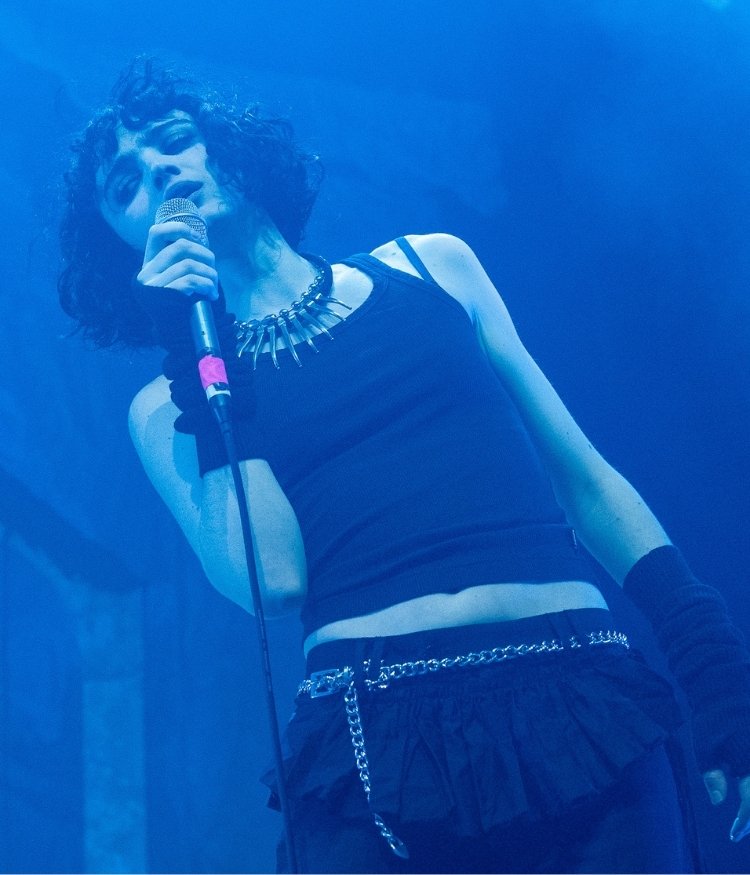
Sir Chloe - image © Thomas Jackson
After each roaring song came a demure, almost bashful thank you; a Jekyll-and-Hyde contrast that felt not rehearsed but deeply true.
The lyrics told a familiar, but still potent story of adolescent and early-adult angst: desire curdling into defiance, vulnerability snapping into teeth.
Lines like 'I don't want love, I want revenge', 'I don't want to hold hands', and 'make me behave like an animal' formed a loose manifesto; not nihilistic so much as allergic to sentimentality. Love here is a threat. Control is the enemy. Agency is hard won.
One song spiralled around the image of a 'monster from hell', the band and crowd rocking together, unified by a shared recognition: the monster isn't something you defeat; it's something you learn to live beside.
Musically, the set flirted with excess; distortion thickened by backing vocals piped in, but the emotional honesty carried it through. There was nicotine and ketamine in the metaphors, sweat and breath in the room, a sense these songs weren't being performed so much as survived.
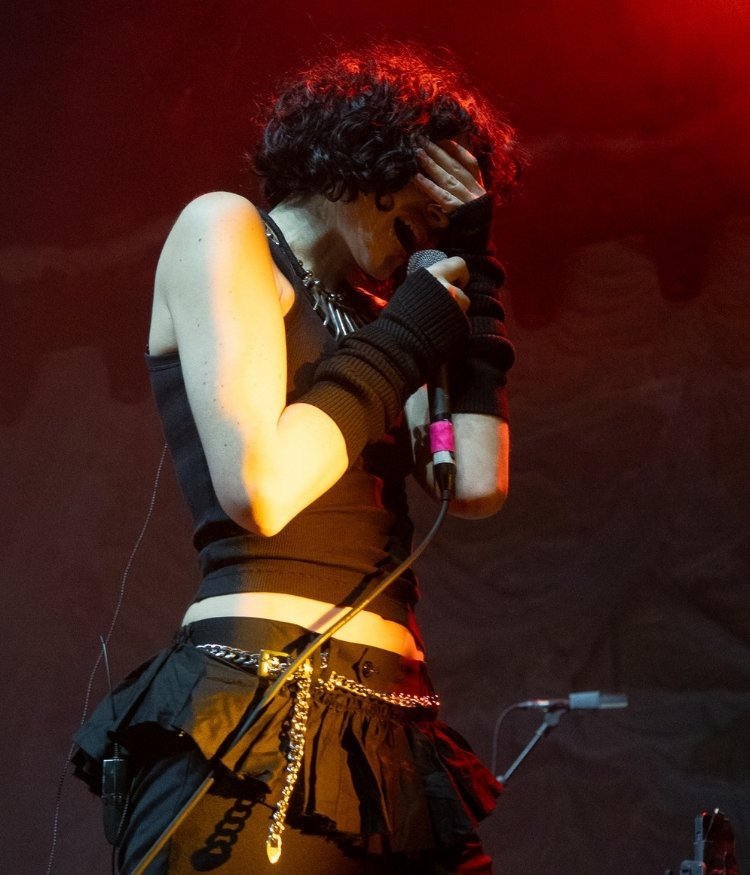
Sir Chloe - image © Thomas Jackson
A red bow tied to the bass, a nod to OzHarvest (whom The Last Dinner Party support), which was a quiet reminder that even rage can be generous, that fury doesn't preclude care. Sir Chloe didn't soften the room. They cracked it open.
By the time The Last Dinner Party took the stage, the crowd was primed and the band knew it. From the dressing room, they'd heard Sir Chloe and sensed the promise of the night ahead.
The set unfolded beneath three arches, one crowned with a church bell, backed by a heaving linen wall that shifted colour like a living organism – at times lace-curtained intimacy, at others something closer to 'Stranger Things'' apocalyptic shimmer.
A metallic bird mobile hung mid-stage, lights casting its shadow so it seemed to fly; a motif of flight, prey, and witness.
From the opening run of 'Agnes Dei', 'Count The Ways', and 'The Feminine Urge', the band moved with choreographed abandon: ballroom dances without partners, playground skips across the stage, erotic exhales punctuating lyrics. 'The Feminine Urge' ended with the microphone stand raised aloft like a trophy.

The Last Dinner Party - image © Thomas Jackson
Abigail Morris's Queen's English, rounded vowels rolling through "Adelaide is such a pretty name," could have held attention on elocution alone.
Between songs, the band spoke of their day at Glenelg Beach. Their Australian-born bassist Georgia Davies acknowledged Country, naming 60,000 years of First Nations custodianship, speaking about learning from Elders, community, and care for land.
'Caesar On A TV Screen' and 'On Your Side' returned the band to collective strength. In a quiet pivot, Aurora Nishevci stepped forward for 'Second Best', seated at a piano, singing "I don't know if I'd be a good mother," beneath a bonnet; a domestic image loaded with doubt, history, and refusal.
What followed was one of the set's most striking sequences: a prayer-like song anchored by a '4am' lyric ('Agnes Dei'), voices stripped back to a cappella harmonies, then 'Woman Is a Tree'; a Kate Bush–esque crescendo that fell away to a single voice at the shoreline.

The Last Dinner Party - image © Thomas Jackson
'Gjuha', written about Aurora's Albanian heritage and the ache of language lost through war, was a highlight. A European string instrument twanged beneath the vocals as the band celebrated language as bridge: each word learned a step closer to a culture once severed. The multilingual echoes recalled System Of A Down, but softened, made ceremonial.
A new unreleased song, 'Big Dog' arrived like a forest parable: don't give yourself to pigs or wolves; creature and victim intertwined. Throughout, the crowd didn't just watch; they fed the band. During 'Sail Away', Abigail spoke of songs not being finished until sung back. The audience obliged.
'My Lady Of Mercy' saw the singer step into the crowd, hands brushing shoulders, a moment of shared breath. 'Sinner' was paired keytar and Victorian silhouettes. 'Inferno' burned the stage orange, lights flickering as Abigail stood arms outstretched in crucifixion; Joan of Arc refracted through pop myth.
Then came a rarity: 'Knocking At The Sky', an unreleased song, played live for only the second time ever, and the first in Australia. 'Nothing Matters' detonated joy, a double-decker keyboard rattling the air.
'This Is The Killer Speaking; saw the band march back onstage like a mariachi procession for the encore.
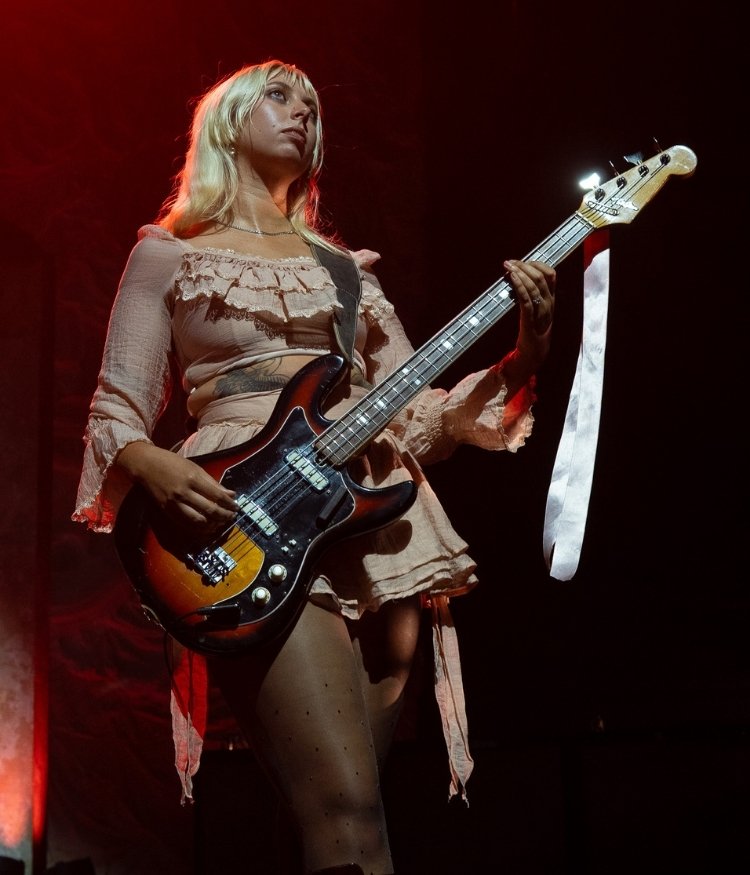
The Last Dinner Party - image © Thomas Jackson
Between it all, Abigail delivered one of the night's sharpest comic turns: "I'm about to give you a masterclass in modern dance. My qualifications? None of your business. Don't kick people behind you; we're not insured for that."
She then named every crew member, dozens of them, from memory. It didn't feel performative. It felt instinctive, a recognition of labour that matched the band's constant refrain: what we're missing is community, accountability, and using your position for good. Ribbons sold for OzHarvest. Provisions for others. Art tied to action without sermon.
Sir Chloe cracked the room open with raw, adolescent fury; the sound of becoming something sharp enough to survive. The Last Dinner Party gathered the fragments and shaped them into ritual: messy, generous, theatrical communion.
Together, they offered something rare: a night where anger wasn't dismissed, tenderness wasn't weaponised, and the crowd didn't just witness, it participated.
For a few hours, we weren't just at a concert. We were inside a portrait.