
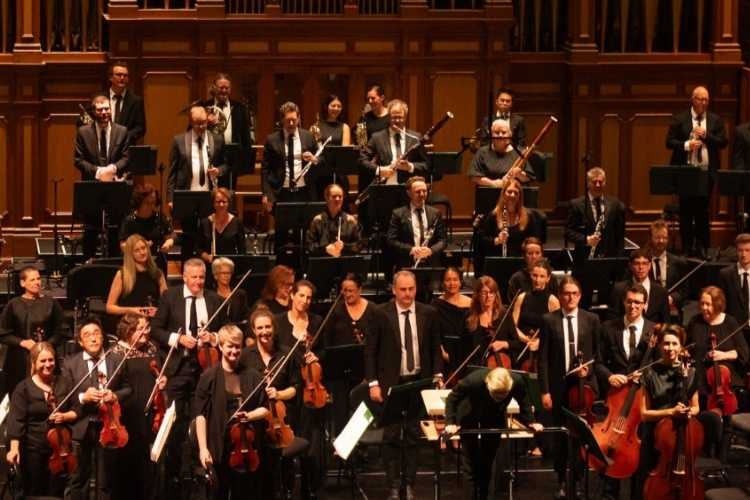
Adelaide Symphony Orchestra continued its Symphony Series last month at Adelaide Town Hall.
The concert, In The Quiet, began in a breath of stillness (18 April). The soft, elusive voice of the cor anglais emerged first, before giving way to a solitary trumpet fanfare, both moving and restrained in Aaron Copland's 'Quiet City'.
Written in 1939 as incidental music for a play of the same name, it was, in the composer's own words: "Calling for music evocative of the nostalgia and inner distress of a society profoundly aware of its own insecurity."
A composer constantly attuned to the world around him, Copland translated the shifting moods and anxieties of his time into music that quietly reflects the society from which it emerged.
His engagement with the zeitgeist unfolds not through narrative, but through atmosphere. In the ten-minute standalone orchestral reduction of the work following the play, he does not so much depict the urban experience as distil it, transforming the tensions of mid-century American life into a language of pared-back lyricism and spacious restraint. It is music that breathes as much in its silences as in its sound.
Principal trumpet David Khafagi captured this fragile landscape with a stunning fanfare of striking clarity, his tone rising and hovering above the gently shifting strings below.
In quiet dialogue with principal cor anglais Peter Duggan, their lines delicately met and parted with a tender intimacy. A tonally ambiguous interplay of solitude and longing, of echo and reply, drifting through related pitch centres without resolution.
The result was music that felt both anchored in its moment yet curiously unbound by it, the meaning left open, suspended in the stillness it so carefully shapes.
Sirens lightly filled the air, with a clarinet solo rising above the distant chaos, something that felt like a childhood dream suspended within a reality of risk and adrenaline.
We are now in a more modern sound world, yet one still shaped by the same underlying impulse: to translate the pressures, fractures, and quiet unease of present-day life into sound, and in doing so perhaps hold a mirror to the society from which it emerges.
Joe Chindamo's premiere clarinet concerto 'Concerto del Motore', or 'Engine Concert', written for Dean Newcomb, carries this idea forward in a distinctly modern language.
It is a playful take on the machinery of the present moment and the human pulse within it, where precision and passion blur, and the restless urge to test one's own limits becomes both gesture and meaning.
The first movement, titled 'The First Revolution', seems to gather this energy at its core, as the orchestra answers the clarinet's call as though inward emotion has been turned outward in a surge of adrenaline, doubt, and focus unfolding in real time, reflective of its time and place and the soloist's love of motorsport.
Dean, who loves his V8s in a city that plays host to the world's biggest 'bogan race', stands onstage performing the new composition entirely from memory on both A and B♭ clarinets.
He becomes the driver on the track Chindamo has created for him, yet for a moment at the end of the movement he takes full command of the wheel in a solo cadenza, drifting through bends of short, flighty passages that lean into the lively jazz-inflected character of Chindamo's writing.
It is evident in his command and artistry why Dean is so respected by Adelaide audiences: a world-class clarinetist whose presence onstage carries both authority and ease.
In 'Quiet In The Noise', time seems to loosen its grip, as though it has decided to drift. The music folds inward, finding lyricism tucked inside the motion itself – those fleeting moments of stillness that manage to hold on even when everything is moving too fast. Beneath all of it is a slightly anxious undercurrent, the sense that vulnerability and mastery reside in the same place.
The finale, 'Asphalt Cathedral', erupts into a display of torque and technical brilliance. The blare of horns, the rush of sirens, the constant churn of a city in motion, are conveyed effortlessly by Sami Butler on the snare.
The clarinet cuts through this density with less authority in this instance; more like running from the cops than crashing into something. Dean holds pace and sends his clarinet into overdrive.
You really get a sense of just how much impact Chindamo's work has when you look around from the alcove of the Town Hall and see over half the audience smiling as this carnivalesque, slightly unhinged soundscape, somewhere between a chase scene and a MarioKart lap through Sweet Sweet Canyon, unfolds in front of us.
As the orchestra builds toward its monumental conclusion, what remains is a sense of culmination, where kinetic force resolves into structure, and human connection ultimately prevails over mechanical movement.
This marks the second concerto Joe Chindamo has written for the Adelaide Symphony Orchestra; a relationship that now feels less like a commission and more like an ongoing conversation.
The first, 'Ligeia' – his haunting work for trombone and orchestra, premiered in 2022 for the Orchestra's principal trombonist Colin Prichard. It was met with resounding acclaim, later travelling to Europe where it was taken up by Peter Moore of the London Symphony Orchestra.
Joe has now written for nearly every major ensemble in Australia: Melbourne Symphony Orchestra, Tasmanian Symphony Orchestra, Australian Chamber Orchestra, and maintains a long-running collaboration with violinist Zoë Black.
Add to that two ARIA nominations and an OAM in 2022, and it's clear things have been going rather well. What really makes Chindamo interesting isn't just the resume, it's where he came from.
Before all this, he was a world-class jazz pianist, working in TV orchestras, film scores, and the session musician circuit (including a stint on 'The Bert Newton Show' back in the late '80s).
You can still hear that world in his music – instinctive, freer around the edges, never too polished to breathe. He is an artist who seems to turn everything he touches into something a little bit magical.
While his rise has been quick, it never feels accidental, more like the natural result of someone who genuinely loves what they do and wants to give back to his audience.
Sergei Rachmaninoff's 'Symphony No. 2' in E minor, Op. 27, sits comfortably among the most adored Romantic works in the orchestral repertoire – the kind of piece that doesn't just sing, it swoons.
After the spectacular collapse of his First Symphony in 1897, Rachmaninoff didn't so much stop composing as disappear into a three-year existential crisis, convinced he had run out of musical ideas altogether. The eventual success of the Second in 1908 didn't just restore his reputation, it restored his faith as a composer.
Written around the same time as his symphonic poem 'The Isle Of The Dead', you can hear that fascination with mortality and spirituality threading through the symphony, particularly in the darker corners of the scherzo and finale. It is Romanticism with a shadow behind it: beautiful, but never entirely relaxed.
If you're not someone who usually listens to symphonic music, there's still a good chance you've crossed paths with it without realising. The third movement in particular has had a surprisingly busy afterlife outside the concert hall.
It has been reworked into power ballads like Eric Carmen's 1976 hit 'Never Gonna Fall In Love Again', and Barry Manilow's 'If I Should Love Again' in the early '80s. Even jazz trumpeter Chet Baker borrowed its DNA on 'You Can't Go Home Again'. Turns out Rachmaninoff wasn't just writing melodies – he was accidentally writing pop hooks that refuse to stay in their seat.
Guest Franco-British conductor Stephanie Childress radiated a distinctly feminine presence. She was compelling to watch, drawing out the emotional intensity the Romantic masterpiece demanded.
In what is so often a man's world, she shone onstage, and this was a real treat to witness. The work's full 60 minutes unfolded through her gestures, the Orchestra held in disciplined unity, as if gathered in the resonant force of her command.
Speaking of my hometown orchestra, the intonation and overall sound have never been in better shape. The woodwinds and brass were positively glowing, at times downright majestic, and the percussion section seemed to be having one of those nights where everything just lands exactly where it should.
That said, the strings had a few. . . enthusiastic moments. In the main theme of the 'Rach II', entries crept in a shade early here and there, and the sense of togetherness wavered slightly.
I have a few theories as to why, but the leading suspect is likely the venue. This is a work of such large scale that it arguably stretches beyond the limits of the Adelaide Town Hall.
In a city that is perhaps not so much a 'quiet city' but rather the self-proclaimed 'festival state' we live in, it raises a broader question of whether we should be considering a dedicated concert hall or arts hub capable of accommodating works of this magnitude.
Maybe then orchestral management wouldn't need to place discounted hearing check vouchers on every seat. Overall, this concert was wonderful programming, and bravo to the ASO.