This year's Australian Women in Music Awards (AWMAs) conference was themed 'Youth, Leadership and Legacy'.
Staged at Queensland Multicultural Centre at Kangaroo Point in Brisbane on Wednesday (8 October), I was keen for a full day of conversation, storytelling, and celebration.
Convenor and emcee Yumi Stynes opens with humour and candour, reminding the room that feminism, consent and collaboration are living conversations, not relics of the last decade.
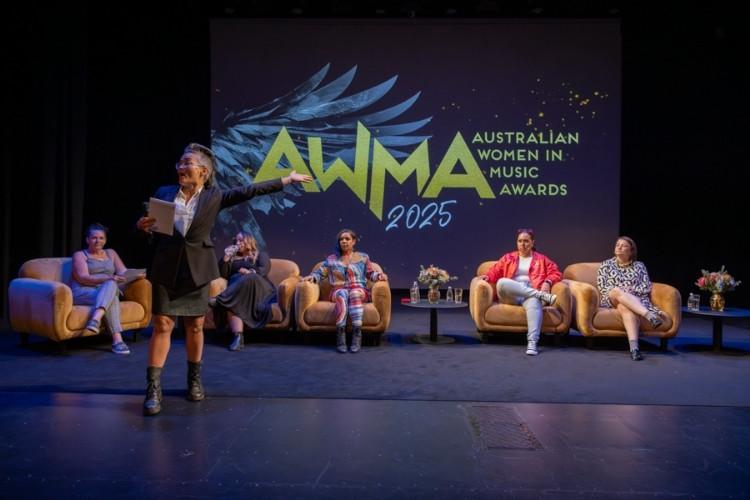
Image © Clea-marie Thorne
Welcome to Country is warm; Gaja Kerry's grounded welcome is part history and language lesson, inviting the audience to recite language along with her giving the collective healing energy and a blessing to close.
Forum 1: Support Act Yarning Strong Forum – JUJU, MUNJIMUNJINA JANGKURR: Words from Deep in the Bush
Our day begins with four First Nations women from the Gulf Country bringing truth to the room. Stories of their history from deep in the bush where songlines, language and survival intertwine.Guided by forum facilitator Dr Shellie Morris AO, the forum unfolds like a journey through memory, crossing cattle stations and campfires where women have been keeping story alive for generations.
They speak about care, ensuring no song is sung in the wrong place or time. "My sister," one recounts quietly, told me "I don't want to hurt people when we sing these songs." It was directed at their music needing to carry truth, not bitterness.
Songs like 'Barkly Tablelands' recall ancestors who worked for flour, sugar and tea, yet the tone stays tender, not accusatory. "It's not about condemnation," we are told. "It's about truth. Because without truth, people are never going to be free."
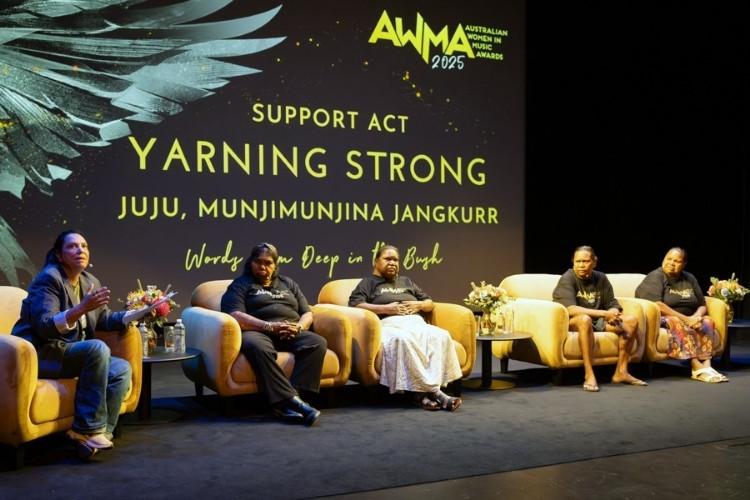
Image © Clea-marie Thorne
Another tells of praying to her great great grandmother to help her find language through song. The emotion ripples through the room. You feel how her grief and pride are stitched together by harmony.
Humour lightens the weight. They laugh about sleeping on their bags at Sydney Opera House. "[Sydney] Opera's got the best sleeping rooms!" one jokes, remembering their first big-city performance with Arrkula Yinbayarra.
Since releasing their 2023 album 'Waralungku', they say their songs are echoing through town camps at Borroloola, and kids singing in language makes them proud. They recount a time when driving and one tells the other to "pull up! They're singing our song!" We all laugh, and feel her joy lighting up the room.
As the forum winds down, they talk about balance, legacy, and belief. "We've been doing grief for 60,000 years," one says. "Now we're doing healing." They close with the same quiet conviction that carries their music, that success isn't about charts or fame but about keeping culture strong. "If I can do it, others can too."
Forum 2: The Young and the Restless (in partnership with Space Girls Festival)
The Space Girls forum shifts the focus to the next wave. Young, gender-diverse musicians rewriting what the industry can be.It starts with AWMAs founder Cindy Vogels sharing how hardship, single motherhood and her daughter's need for safety in music became the seed for Space Girls' rebirth as a proudly queer-safe creative platform. Behind her, a montage of regional artists and youth, the Space Girls family.
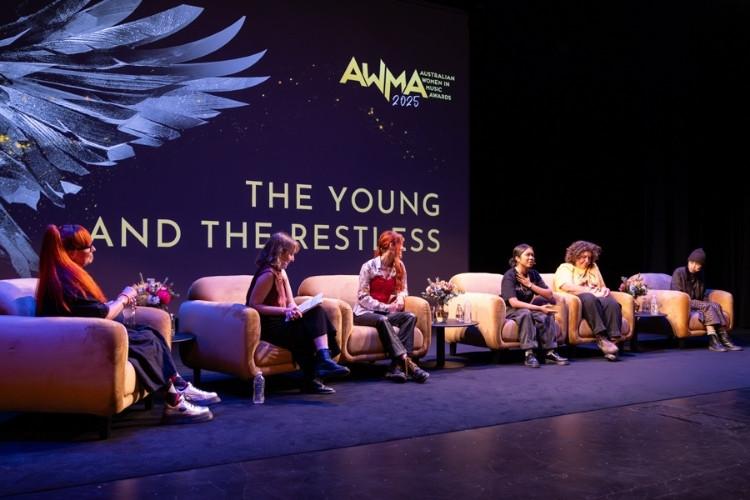
Image © Clea-marie Thorne
Songwriter Georgie Taylor (24) steps up to lead four rising voices in a candid, funny, and deeply honest exchange. Each brings a different rhythm: Ella Joy (22), a Christian artist from Gubbi Country with over a million streams; Lily Morris (23), a folk-rock mentor helping rural kids start bands; ixaras (18), a DIY punk-turned-storyteller from Brisbane running her own label; and Jemzel Costales (19), a queer folk-soul artist fusing theatre and feminist narrative.
When Taylor asks them to hype themselves up, humility drops away, replaced by gratitude and grit. They talk about mentorship, representation and redefining success not as fame but survival and connection.
The conversation digs into the realities of burnout, online toxicity and financial precarity. Each of them describe juggling multiple jobs, study, self-promotion and the pressure to stay visible.
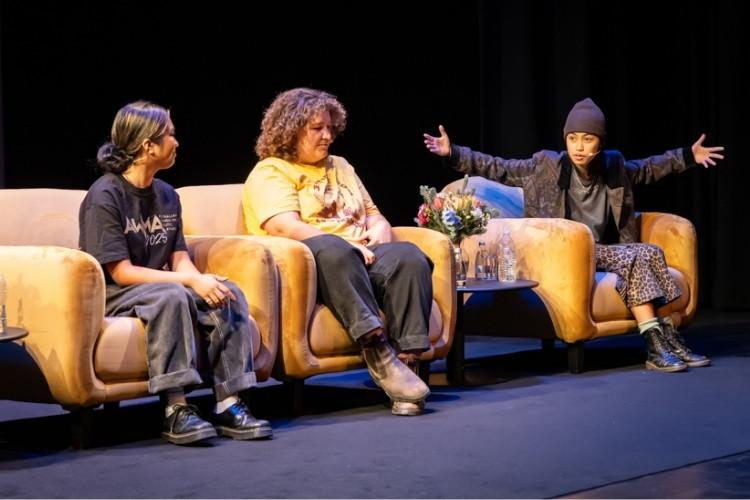
Image © Clea-marie Thorne
Yet none of them speak in defeat. They call for mentorship instead of gatekeeping. For schools to foster creative careers. For safe spaces in every postcode. Their words feel less like complaints and more like blueprints.
By the end, the energy in the room feels future-facing and fierce. These young talents are not asking for permission, they're building their own systems, their own shows and their own communities. As Vogels puts it: "This is what the next generation of Australian music looks like. . . unfiltered, unstoppable, and unapologetically themselves."
In Conversation – Brittany Long: Access, Art, and Advocacy
When Brittany Long rolls onto the stage the room stills with respect. Known for capturing the pulse of live music from both pit and platform, Long talks about carving a career in a space that rarely considers accessibility."Accessibility isn't about ramps," she says. "It's about inclusion. There are people in wheelchairs who want to be in the wall of death at a metal gig. . . not stuck at the back."
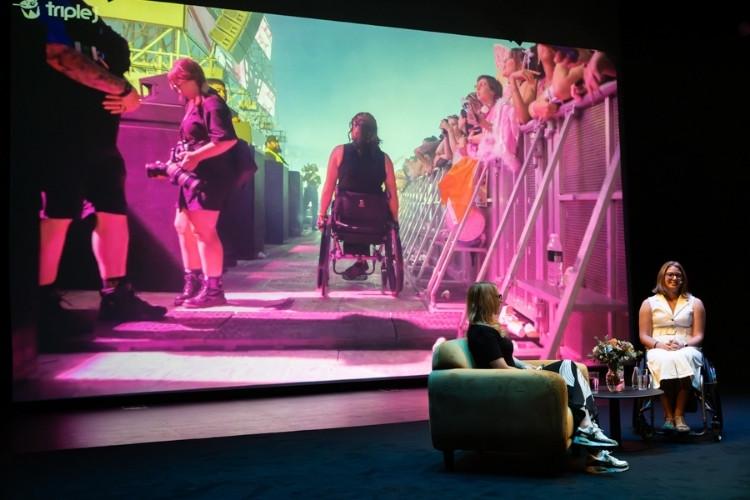
Image © Clea-marie Thorne
Her story unfolds like a documentary in motion. Starting in maternity photography, she stumbles into live music by accident, sneaking a camera into a P!nk concert, falling in love with the electricity of performance and shooting her first proper gig at Melbourne's Bar Open.
From there, it's persistence and grit: cold-emailing venues, landing her first pass for Alex the Astronaut (with Paul Kelly as surprise guest) and eventually joining Getty Images' entertainment team.
Behind the lens, she's redefining what 'access' looks like, one photo at a time. Her ongoing portrait project Stairing Through The Lens began in 2019 – artists photographed seated on staircases across Australia.
Each portrait is quiet but political, a literal reminder of the barriers she faces and the change she's demanding. "If I can shift one mindset," she says, "the ripple effect will do its job." The project now includes over 260 portraits and has sparked venue redesigns and artist-led accessibility initiatives.
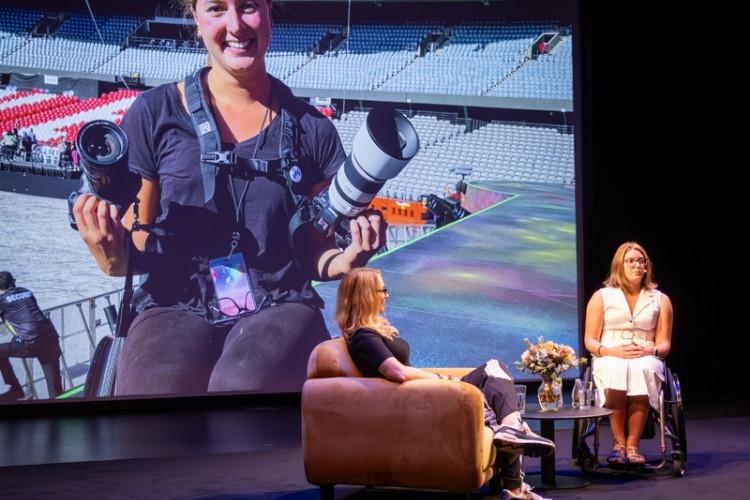
Image © Clea-marie Thorne
Images of Long and the many artists she has captured in precarious situations are showcased on the digital backdrop as interviewer Tiana Speter prompts her on legacy.
Long tells us of the struggles she faces and gives us a glimpse of her tenacity that she draws from to overcome obstacles to follow her passion while being a voice calling for those same obstacles to be removed for workers and others with disability wanting to enjoy and participate in the world of live music.
In closing, Long's voice softens: "At the end of the day, everyone wins when accessibility exists. It hurts no one and it changes everything." Her story isn't just about photography; it's about reimagining who gets to belong in music. The applause that follows feels earned, not polite.
Forum 3: Balancing the Mix: Redefining Tech (in partnership with WOMP: Women of Music Production)
Facilitator Elise Reitze-Swensen opens the session with a laugh and a line that hits hard: entering the tech side of music is "like walking into the haunted house that is the very sexist music industry and the worst room in it, is the tech room". The panel bursts into knowing laughter.From there, the conversation dives into reclaiming power through production. Reitze-Swensen describes WOMP (Women of Music Production) born from five women over "wine and cheese" and now a national mentorship movement.
Candice Lorrae, Becki Whitton, Emily Hopley, and Eve Klein swap metaphors for producing. From "building a house for a song to live in" to "cooking something that nourishes people". Klein grounds it in motherhood and mid-career invisibility. "There's funding for emerging artists, but nothing for women starting again after kids," she says.
Applause ripples through the room as she argues for recognising mid-career artists as vital cultural voices, not expired ones. They talk allyship, access and ethics, men who walk the walk, mentorship built on safety not hierarchy, as well as the moral duty to protect artists' stories in the studio.
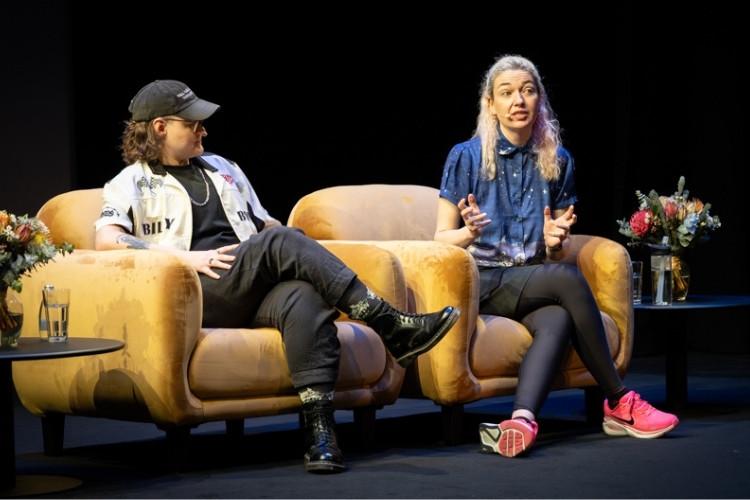
Image © Clea-marie Thorne
Lorrae shares her work with the Archie Roach Foundation's Singing Our Futures programme. We're told about a new label supporting women and gender-diverse art-music creators and there's a rowdy reaction when we hear "if your sound doesn't fit the mould. . . we'll make a new one".
The conversation closes with practical wisdom. Regional artists ask how to stay connected; the panel answers with collaboration tools, remote mixing and the Music Bush Fund. Remote creatives are told to "find your peers, not just your heroes".
Lorrae grins and encourages them into freeform exploration: "Yeah. . . f... around and find out." The crowd erupts. The haunted house of tech doesn't feel so haunted anymore, just alive with women switching the lights on.
Forum 4: Leading Through Disruption: Innovation & Adaptation (in partnership with WOW: Women of the World)
Facilitator Jo Pratt opens with laughter and fire, steering the conversation toward women leading from empathy, not imitation. "Women are disruptors by nature," says Maggie Collins, describing quiet rebellion through kindness and boundaries.Kaylah Truth reframes disruption as "not being the loudest, but being the realist in the room". While Dizzy Doolan grounds it in the everyday juggle of motherhood, touring and creative survival. "Disruption," she says, "is just breaking down brick walls. . . and doing it with integrity."
As the talk deepens, the emotional labour surfaces. Women reforming broken systems while being expected to hold them together. "People can call bullsh,t," says Truth. "Vulnerability is the biggest disruption we have," Doolan adds. "You can't be what you can't see."
Their stories ripple through the room: exhaustion, persistence and pride in mentoring the next wave. The forum shifts from ideology to action: tax reform, accessible childcare, transparent grant systems and safety for women working late. "Pay me properly," Truth says bluntly and the crowd cheers.
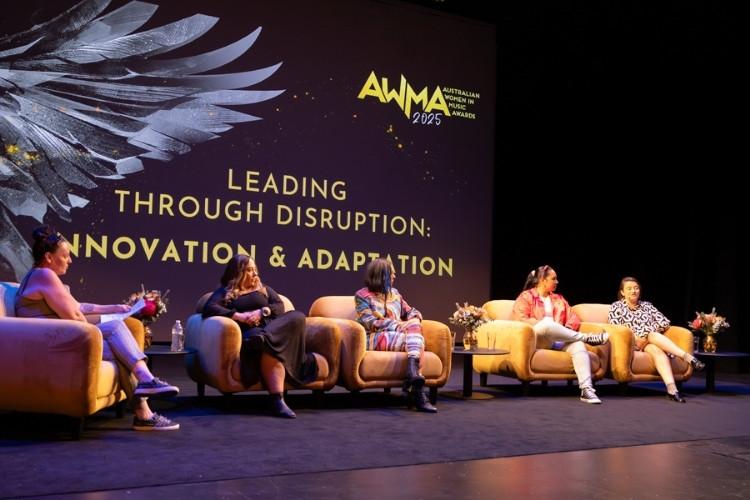
Image © Clea-marie Thorne
Then comes the moment that stops the room. "Stand if you think gender equality will be achieved in your lifetime," Pratt says. Only one person rises. The silence cuts deep. "Is that for black women or white women?" asks Truth, and the reckoning is real.
The panel reclaims hope as resistance. Doolan's belief in the next generation, Kearna Sweeney's pride in her daughter's strength. "We've been singing and stomping the land for 65,000 years," Doolan says. "This is just modern-day storytelling."
By the Q&A, the mood is defiant and electric. Asked how to navigate misogyny in hip hop, Doolan grins: "Be persistent. . . when women bring it, we bring it tenfold." Truth adds: "Be better than them; and if they piss you off, put it in your raps and make money off it." The crowd roars.
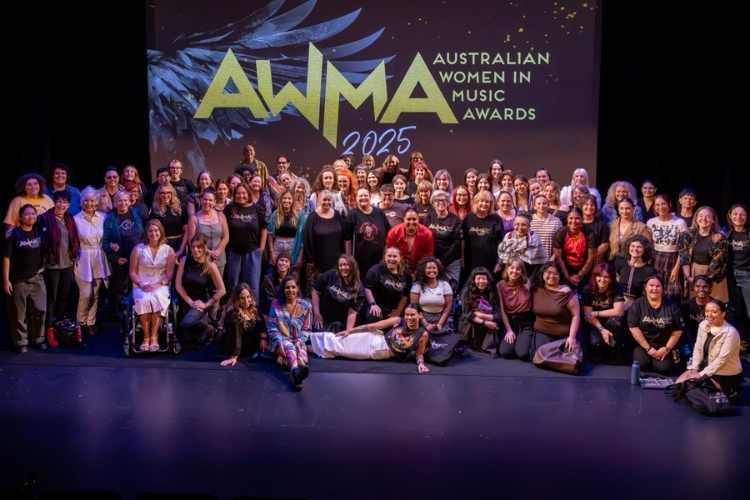
The forum ends in laughter, applause and revolution-talk. "Every day," someone shouts. "Time for talking's done." Our day closes with a group photo of almost 100 faces – fierce, funny, and fired up for change.
More photos from the conference.
