
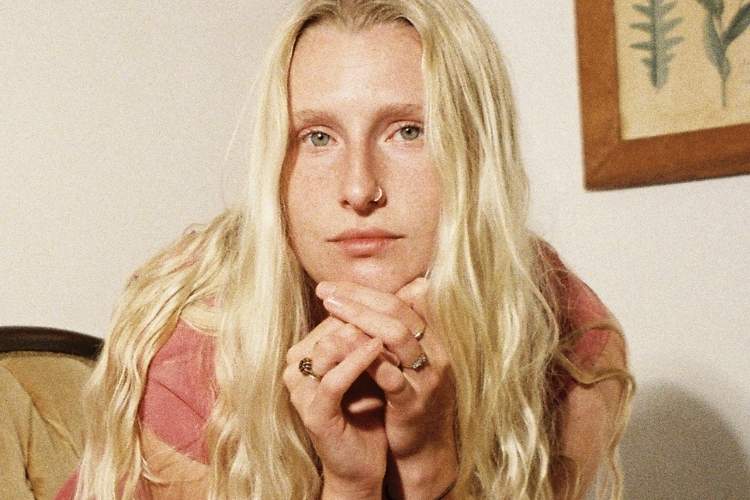
After a sold-out run January 2025, Yorkshire-raised, London-based Billie Marten returns to Australia next month, bringing her most expansive and confessional era yet.
With Maple Glider confirmed as the support act, the tour (Brisbane, Sydney, and Melbourne plus Billie appearing at Party In The Paddock) promises an intimate double-bill of emotionally resonant songwriting.
Known for tracks like 'La Lune', 'Vanilla Baby' and 'I Can't Get My Head Around You', Marten has built a devoted audience around her intricate indie folk and quietly devastating lyricism, earning comparisons to artists such as Julia Jacklin and Laura Marling.
Her latest album, 2025's 'Dog Eared', marks a subtle but significant shift: fuller band arrangements, loosened control, and a deeper trust in process.
Ahead of her return to Australia, Billie spoke about vulnerability, creative rituals, the discomfort of explaining songs, and why some lyrics only reveal their power once they're sung back by a crowd.
"I seem to go to Australia solely in January and February, when we're all still feeling quite raw and sort of beginning the year in a vulnerable way," she reflects, "which is actually a really nice time to go to a concert, I guess."
This time around, she says, there's a new emotional tone to her visit. "Because Australia is somewhere I haven't been more than once, it brings a more positive and hopeful side of me. I'm looking at things with fresh eyes and ears."
It's a subtle shift in perspective that feels deeply aligned with the emotional arc of her most recent work.
With five Billie Marten albums now in the world, the question of whether her work documents her life or actively shapes it feels unavoidable. Marten's answer is simple: "Yes to both of those things."
She doesn't shy away from emotional transparency in her writing. "I know lots of people don't like the term 'confessional songwriter', but I actually think it's very accurate with me. I'm totally fine with that label."
For Marten, songwriting began as something intensely private. "From a very young age, I used songs as a place to put away my hidden or secretive feelings."
She didn't grow up with a music community or the language of experimentation. No GarageBand sessions, no collaborative songwriting circles. Just herself, and her thoughts.
That solitude still echoes through her work today, but it's now paired with a growing willingness to invite others in.
'Dog Eared' feels like a deliberate loosening of control: sonically expansive, structurally fluid, emotionally exposed. That ethos extended directly into the recording process.
The album took shape in producer Philip Weinrobe's Brooklyn studio with ten musicians in the room. "They were simultaneous processes," she explains of writing and recording.
"We would meet in the morning, phones in a tray, go in the studio. Phil would make me sing the songs in front of everyone. . . sometimes ten musicians in the room, and then instantly people would pick up something and we would start going."
The result was an environment that felt closer to collective instinct than careful construction. "We're all so used to incrementally layering things, when it can just be an instant sort of explosive process."
For Billie, this was liberating. "It was great for me, because I felt like I could do a lot less."
Despite Marten's reputation for emotional openness, there are still boundaries she protects. "Well, you could say explaining the songs. I never enjoyed doing that."
She references Radiohead's long-held refusal to explain their songs. "What is the point with doing that?" Still, Billie acknowledges the value of shared meaning. "There are songs I know and love that I'm so glad I know the story of."
Her approach sits somewhere in the middle: offering fragments, but never the full picture. "I might give you one meaning of the song, but I won't give you the entirety. Sometimes the songs aren't about anything," she jokes.
'Leap Year', for instance, prompted concern from friends. "A lot of people were asking me, 'What's going on about this person you're talking about?' And they're not real."
Even 'Swing' is exactly what it sounds like. "Being on a swing, and being an adult." Yet she still believes in the underlying honesty of songwriting. "I do believe everything that comes out of you as a writer is the honest truth. . . you are blatantly saying exactly what you mean."
Marten often speaks about the role of nature and literature in shaping her inner world, but lately inspiration has arrived through something more domestic.
"Radio 3, which is a classical radio station. I have a radio in my kitchen and I leave it on all day. It's the first sound I hear in the morning and it's the last thing I turn off."
Rather than distracting her, the constant presence of music does the opposite. "For some reason [the radio] is very stimulating to me. It provides a bed that's not silenced, but it's also not lyrical.
"It helps me to understand the song you're about to write is not coming from nothing. You don't have to start with silence or an emptiness. It makes it a lot less terrifying to write a first note."
For newcomers, Marten offers three songs as entry points to understanding her as an artist. "'Vanilla Baby'. That's the song with the least amount on it. Purest form.
"'Willow'. It feels very comfortable to me but not in an easy way. . . it felt true to all stages of myself. Plus there's a clarinet solo in there that I really like. 'Clover'. Sonically, that's where I'm fitting at the moment."
What lingers most after speaking with Billie Marten isn't any single quote, but the depth of consideration behind everything she says.
She listens carefully. She chooses words with intention. She resists oversimplification in a world that constantly demands it.
As she returns to Australia, in that familiar season of collective rawness, it feels like the right time to meet her there.
Billie Marten 2026 Tour Dates
Wed 4 Feb - Crowbar Brisbane
Fri 6 Feb - Metro Theatre (Sydney)
Sat 7 Feb - Croxton Bandroom (Melbourne)
Sun 8 Feb - Party In The Paddock (Launceston)