'The Lion King' romps into Sydney’s Capitol Theatre with stunning visuals and slick design, but its roar could be stronger.
Nearly three decades after its Broadway debut, 'The Lion King' remains one of musical theatre’s most loved productions. Now playing at Sydney’s Capitol Theatre, this return season proves why it is a global phenomenon: it transforms a beloved animated film into something richer, stronger and more theatrical than its source material. What unfolds is a living, breathing artwork of movement, colour and craft.
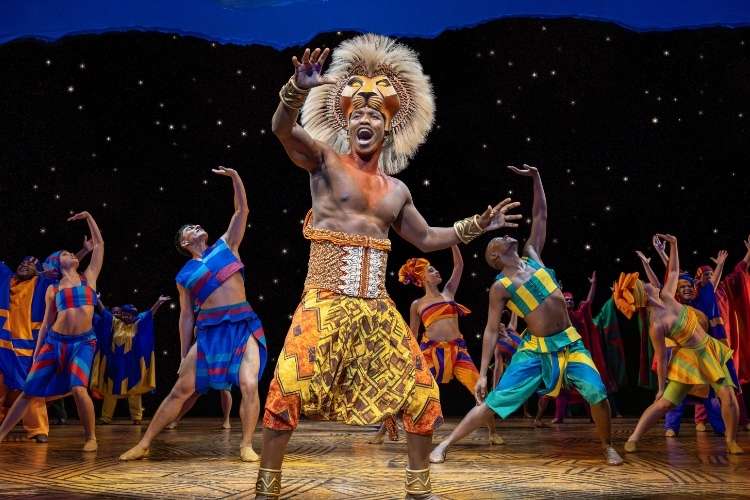
The show’s extraordinary mask, puppet and costume design is on full display from its start. Courtesy designers Julie Taymor and Michael Curry, towering and graceful elephants stride majestically through the aisles, while immense giraffes glide across the stage on performers’ stilts. Hyenas skitter and snap with sinister, skeletal energy, and lions are rendered through masks that allow performers’ faces to remain visible, preserving both the animal’s majesty and the performer’s expressions. The fusion of African artistic influences in their design with inventive theatrical engineering in their operation gives the production its visual language. The result is deeply immersive and highly successful.
That immersion is heightened by the lush scenic design (Richard Hudson), which vividly conjures the Pride Lands in their shifting moods. Sweeping grasslands pulse with life, shadowy elephant graveyards are menacing, and desolate wastelands feel drained of hope. Scenic transitions are fluid and cinematic. There is a handcrafted richness to the onstage world, where fabric, light and movement masterfully enliven landscapes rather than merely depict them.
The choreography (courtesy choreographer Garth Fagan) is equally dazzling. Numbers such as 'I Just Can’t Wait To Be King' and 'Hakuna Matata', with music and lyrics by Elton John and Tim Rice, burst with joyous energy. What makes this remarkable is the complexity involved: performers must execute intricate movement while manoeuvring oversized masks, manipulating puppets or balancing on stilts. That the choreography appears so slick and effortless is a testament to the extraordinary skills of the cast. Every gesture feels purposeful, and every formation elegantly shaped.
Among the cast, Daniel Frederiksen delivers a stand-out performance as Scar. He masterfully captures the villain’s wit, intelligence and arrogance, finding a menacing tone in Scar’s disdain and manipulation. His scenes crackle with tension and his command of the stage is strong.
Jamie McGregor as Timon is spirited and immensely charming, with great comic timing and warmth. His performance reflects the fun, lackadaisical traits of the film character, making the stage equivalent dynamic and a clear audience favourite. Benn Welford, meanwhile, steals the show as Zazu. His performance is sharply comic, expertly judged and full of character detail, and showcases impressive musicality. Welford turns every entrance into an event.
The child actors portraying Young Simba (Dev Raval) and Young Nala (Wilhemina Umeh-Nicholas) deserve considerable praise. Both hold their own admirably, bringing confidence, sincerity and youthful spark to the story’s emotional foundation.
Where the production falls short is its sonics. Under music director and conductor Laura Tipoki, the orchestra is polished and supportive, yet it lacks the same commanding force as the visual elements surrounding it. The score feels softer than it should, particularly in moments that require greater rhythmic punch or emotional sweep. Similarly, some of the singing does not match the grandeur of the design, staging and movement, occasionally restraining the performance where greater vocal power would have lifted the show to stronger and greater heights.
Nonetheless, 'The Lion King' remains a triumph of theatrical imagination. Its return season at the Capitol Theatre is as transporting as ever, and a reminder that live performance can still astonish.