
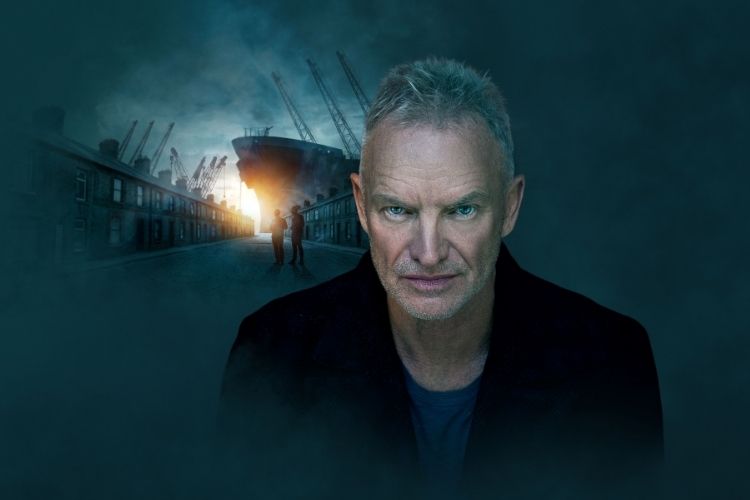
The appreciably wryly named 'launch' of 'The Last Ship', a musical written by Sting, was at Brisbane’s newest venue, QPAC’s 1,500 seat, state-of-the-art Glasshouse Theatre.
Stunning in its depth of vision and almost endless in its soaring ceiling height, the building itself almost appeared to be Brisbane’s gift back to Sting for choosing to stage the musical only here in Queensland, Australia.
Musicals, having lost some of their popularity in the 1950s to variety television, became refreshed and revived by at least one newly developed genre in the '70s – rock operas. It lured people back to the theatre.
The Glasshouse’s awesome stage backdrop provided a mesmeric and teased introduction to what we all hoped was to be more than just a 'good show with some lovely singing attached'. The expectation seemed to be if Sting was heavily involved, then it came with an implied international quality.
Visually, that first hurdle had already been leapt. Time was given to absorb front-of-house optics before the musical started. Facing us, a massive ship's bulkhead – stories high. The stem, the vertical part of the bow - the leading edge - had scaffolding enveloping it as if it was at the shipyard. The blurred line between what was tangible and what were projection tricks, ended up being exhausting. The acceptance it was all real was an easier option.
The storyline was, in fact, intriguing in its Sting-like theatrical simplicity but built on a complex foundation. It mirrored his writing technique which signalled a counterpart to his own song composition. Thinking 'Englishman In New York', 'Fields Of Gold' and 'Fragile' as three fine examples. And out of those, 'Fragile' way back in 1987 seems to point out to the future – this production, the need for social interconnectedness and the relentless nature of everyday survival against harsh, unfair social scenarios, like the imminent closing of a shipyard in the 1970s.
The tale is as old as love itself. However, 'The Last Ship' was strongly original, and Sting and his fellow actors used passages of musical reflection to deliver a credible background, while independently weaving a narrative that’s almost unpredictable, but never ever erratic.
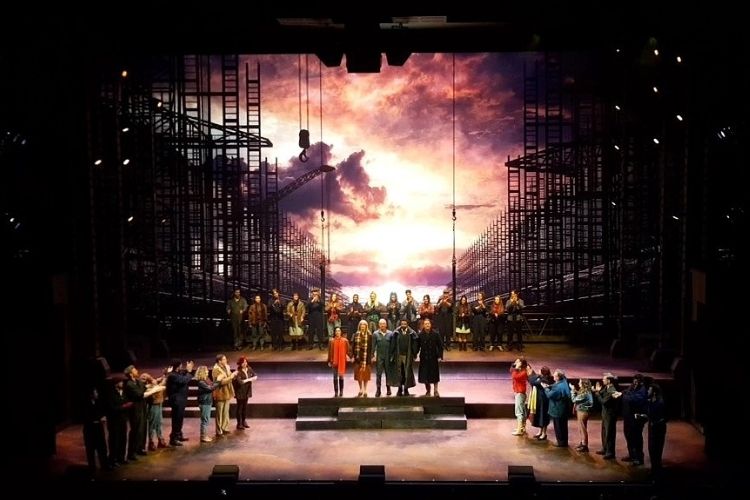
Image © Michelle Cop
Sting played an ageing and ailing shipyard worker, Jackie White, a popular figure, complete with overalls appropriately worn – and worn out. Annette Mclaughlin, as Peggy – was his supportive wife. There was deep affection between them. All of the acting in 'The Last Ship' was convincingly underplayed, it has to be said. What was said was felt. And we get it.
Along with this narrative is another – Gideon and Meg. Declan Bennett and Lauren Samuels playing those parts as if they resided in them for decades. Gideon as the returning seafarer, back to tidy up his recently deceased father’s affairs, only to walk into the result of one he had with Meg – as a bit of a lad. Enter Hannah Richardson as Ellen at that point.
The ominous and foreboding closure of the Government-owned shipyard was ever present and added a tangible tension to the plot. Throughout the production were sensational melodic pieces which paid an enormous homage to the great musicals of the past. Memorable and catchy, uncomplicated and with street-level language. Sing along if you wish. With words discreetly showing on two side screens, nothing was missed, nothing was misheard with unfamiliar accents, including Shaggy, whose occasional appearance and singing made us smile widely.
The moving physical sets, stage effects and live musicians were truly the next level of 3D entertainment. That alone was an intermission talking point. Without detracting in any way from the originality, prestige and joy of the evening, a few patrons expressed the three hours was a tad long. It's genuinely problematic, as the story deserved every single minute put into it, leading up to 'The Last Ship''s jaw-dropping finale. No hyperbole is necessary.
It was singularly successful and worthy of welding a date on a steel calendar.
Words by Stu Robertson and Michelle Cop.