
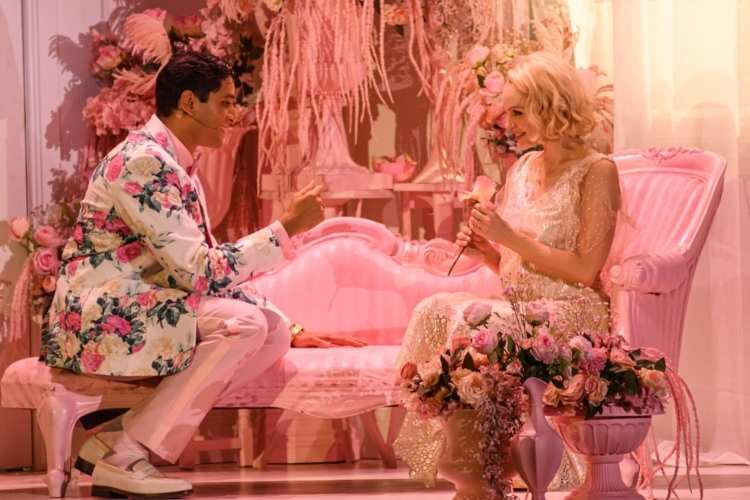
Politically timely, Queensland Theatre Company/shake & stir's production deals with race, class and gender. Though set over 100 years ago in 1920s New York, the play feels fresh, relevant, and bitingly sharp.
Queensland Theatre Company/shake & stir’s production of 'The Great Gatsby' is a lush, tightly wound staging that captures both the glitter and the rot at the heart of Fitzgerald’s Jazz Age classic. Against the backdrop of President Trump’s America, the casting of a man of colour as Gatsby (the excellent Shiv Palekar), the entitlement and racism of Tom Buchanan (a preening Jeremiah Wray), and the juxtaposition of pretty, vapid and trapped tradwife Daisy (Jess Vickers) to Libby Munro’s strong modern Jordan Baker takes on new meaning. The play drips with moral decay, and leaves the audience with the sense that the wealthy will always get away with their crimes.
From the opening moments, the audience is drawn into Nick Carraway’s (Ryan Hodson) recollection of one long, reckless summer. The play opens with a single spotlight lingering on Nick at his typewriter, ghosts whispering in his ear. The adaptation frames the story as memory, moving forward and back through time. A WW1 phantom signals Nick’s distress and trauma from the war, and embodies again his memories as he sits both inside and outside himself, a common refrain from the play.
At the centre of the story is Jay Gatsby, portrayed not merely as a romantic dreamer but as a man fraying at the edges of his own invention. The performance captures Gatsby’s carefully constructed charm, while allowing flashes of panic and vulnerability to surface. His insistence that the past can be repeated lands not as bravado but as desperation. Opposite him, Daisy Buchanan is rendered with a beguiling mix of lightness and calculation. Her voice lilts with warmth one moment and cool detachment the next, reinforcing the production’s suggestion that Daisy is less a villain than a product of her gilded cage.
Nick, often a passive observer, is given significant emotional depth. He is both narrator and participant, his moral unease becoming a central thread. The performance makes clear that Nick’s fascination with Gatsby is tinged with envy and disillusionment. Tom Buchanan, meanwhile, is played with a blunt physicality that underscores his entitlement. Rather than caricature, he emerges as a chilling embodiment of inherited power.
One of the production’s greatest strengths lies in its pacing. Party scenes pulse with music and movement, creating a sensory overload that mirrors Gatsby’s excess. Tinsel curtains fall from the ceiling, and cannons blast pieces of gold glitter onto the audience, bringing the audience into the party, while also heightening the transience of the moment (a note to Queensland Theatre Company – These bits of flashy plastic were used for about five seconds and will be around for hundreds of years – please get a sustainability manager).
The production stays true to the novel’s critique of the American Dream without heavy-handed messaging. Wealth is seductive but hollow; reinvention is thrilling but fragile. Gatsby’s death is not staged as grand martyrdom but as a stark, lonely consequence of illusion. The closing moments, with Nick once again alone at his typewriter, are delivered with restraint. The audience is left not with spectacle but with a sense of moral exhaustion.
In bringing 'The Great Gatsby' to the stage, Queensland Theatre Company/shake & stir demonstrate both reverence for the source material and confidence in theatrical storytelling. The production shimmers, but its true achievement lies in revealing the emptiness beneath that shimmer. It is a visually arresting, emotionally intelligent interpretation that lingers long after the lights fade.