
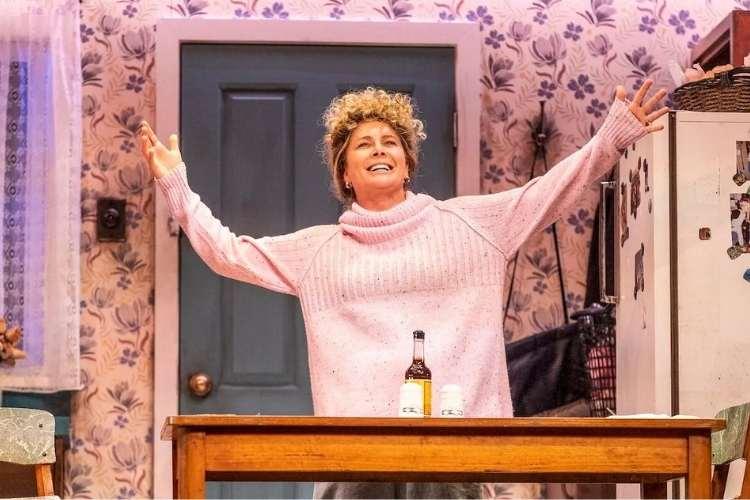
“Why do we get all this life if we never get to live it?”. . . It’s a timeless question Shirley asks, wine glass in hand, standing in her kitchen and lamenting how lost she feels her life has become.
'Shirley Valentine' is a story of liberation and rediscovery. It opens with a mother of two preparing her husband’s dinner, trapped in routine and longing for something more, a life beyond her kitchen, her ungrateful family, and her small-town existence. When she’s offered a chance to holiday in Greece, that longing starts to take shape.
Written by Willy Russell, 'Shirley Valentine' first premiered in 1986 before going on to successful runs on both the West End and Broadway.
While the sentiment behind the show remains relevant – how do we find meaning, spark, and purpose after years of complacency – the storytelling feels dated. As an audience member, I want to believe we’ve moved beyond the idea of a woman whose punchline is wine, and whose problems are both caused and ultimately solved by a man. What may once have felt provocative now lands as somewhat uncomfortable, carrying a slightly problematic and potentially misogynistic undertone.
That said, Natalie Bassingthwaighte’s performance absolutely shone through the material. Charming, funny, and deeply endearing, she commanded the stage for two and a half hours with impeccable timing, an impressive feat in itself, made even more so when done so well. She managed to capture a true genuine sadness beneath Shirley’s quick jokes and funny anecdotes about her friends and family.
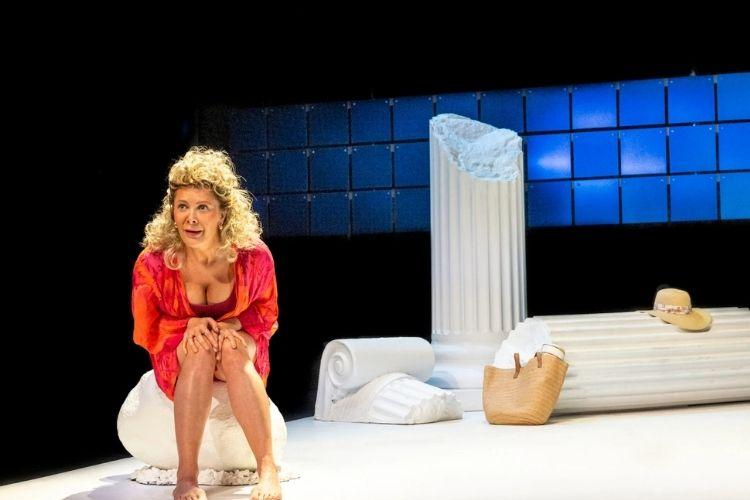
Image © Brett Boardman
The simple, compact set design, maybe chosen for touring purposes, worked well in reinforcing Shirley’s world. In her kitchen, the space felt small, the set closed to a small section of the stage. But in the second act, when Shirley arrived in Greece, the set opened up; the walls came down, and her world expanded with her.
A stand-out element in the show, for this reviewer, was the real cooking on stage. What I first assumed was clever sound design, turned out to be actual food being cooked – the smell of fried eggs wafting through the theatre was an unexpected sensory touch that is rarely seen.
The overall show, from text to design, from set to costuming, didn’t necessarily transport us to the '80s, but it made us feel as stuck in a time period as Shirley was in her own existence.
I couldn’t help but wonder if the themes of liberation, self-discovery, and fulfilment would have had a stronger impact, at least for a younger audience, if any of the show’s elements had been set in the present rather than 40 years ago. The play, as with the original text, ultimately leaves us on a cliffhanger: where does Shirley go from here? Whether or not you agree with her decisions, society has a huge role to play in her choices. And whatever choice she makes, regardless of how it makes the audience feel, an incredible performance from Bassingthwaighte helps you believe she’s making the right ones.
Words: Casey Elder
