'Re-Shaping Identity' does not begin with a blackout.
It begins with a choreographer in a t-shirt and shorts.
Guo Rui stands casually under work lights and explains part of his dance philosophy. He recalls learning folk dances from a teacher whose body had been shaped by hard labour. Shoulders hunched. Neck slightly askew. That posture became part of the dance. Not through doctrine. Not through purity. Through life.
Culture, he suggests, evolves for reasons as simple and as strange as personal eccentricities. So why do we hold on so tightly to rigid versions of it?
That question pulses through this Australian premiere.
Five dancers step forward. Chen Yijie, Wang Huaili, Wu Hui, Gunika Aniwa and Guo Rui represent Tibetan, Uyghur, Mongolian, Yao and Han backgrounds. They speak about identity under a tight spotlight.
Some describe rebelling against their heritage before returning to it. Some speak of identity as land. Tibetan mountains. Altitude. Mushrooms gathered with a father in hillside grass. Others speak of identity as people. Not place. A culture carried wherever you move.
As one dancer speaks, the others respond physically. When there is talk of community, they huddle. When stereotypes are mentioned, bodies stiffen. You see how quickly a group can close ranks. You also see how easily it can fracture.
The choreography pulls traditional vocabulary into focus. Mongolian dance opens the arms wide, echoing the vastness of plains. The torso shifts with the rhythm of imagined horse riding. These are not museum pieces. They feel alive in the room.
Lighting by Low Shee Hoe keeps the space clean. Music blends traditional motifs with electronic textures. A thumping beat begins to seep in. It does not arrive abruptly. It consumes slowly.
There is a striking moment late in the work. A roll of astro turf is pushed across the stage. Artificial grass. Bright and synthetic. Perhaps a symbol of tradition maintained on surfaces far removed from its origin.
Wu Hui’s costume design begins with street clothes. As the conclusion nears, castmates bring out traditional garments and drape them across her body. For a moment, she is framed by expectation. Then at the conclusion, an air-conditioning pipe is placed around her neck. A feather duster is pressed into her hands. It is absurd. Domestic. Almost comic. Tradition can be rearranged. Reclaimed. Or discarded.
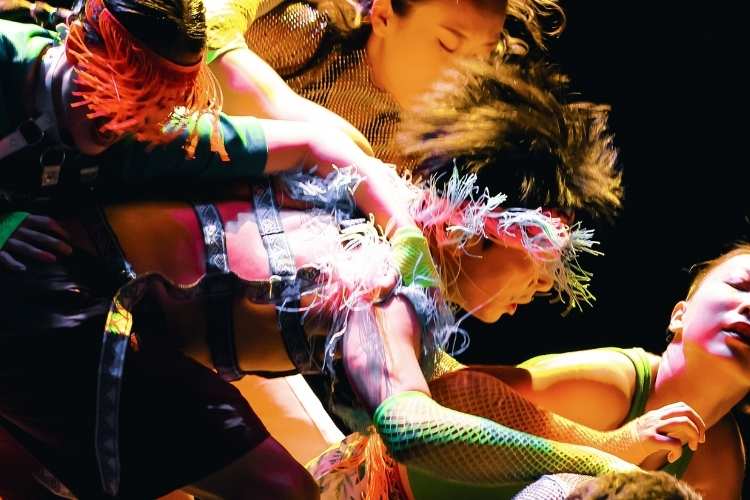
In the final sequence, what appear to be traditional costumes morph into fluorescent rave gear. The electronic beats that had blended with folk melodies now dominate. Strict lines dissolve. Feet stamp not from discipline but from choice. The training of dance school bodies gives way to release.
It is powerful.
Guo Rui avoids simple binaries. He rejects the idea of self as a fixed noun. Identity is presented as a verb. Something enacted in real time. Something shaped by land, labour, community and rebellion.
The work also interrogates stereotypes directly. The dancers speak about being boxed in by ethnicity. About external expectations. About how much individual variation exists within any label. The stage becomes a space where those boxes are opened and rearranged.
There are moments of quiet joy. The image of dancing in Tibetan hills while collecting mushrooms with a father is simple. Tender. It grounds the theory in lived experience.
At times, some sections stretch. The slow evolution of movement motifs can feel repetitive. For untrained eyes, the micro-shifts in weight and intention may be less visible. A few sequences hover on the edge of monotony. Yet that patience is also part of the argument. Identity does not pivot in a single dramatic turn. It shifts incrementally.
Community engagement sits at the heart of several performers’ practices, particularly Chen Yijie, whose work explores marginalised communities. That ethos is visible here. This is not spectacle for spectacle’s sake. It is inquiry.
The show reframes folk dance not as relic but as living material. Something that can be intervened in. Something that can liberate rather than constrain.
When the heavy beats take over and bodies pulse under neon hues, the shift feels earned. The dancers are not abandoning tradition. They are digesting it. The past is not erased. It is metabolised.
'Re-Shaping Identity' asks who performs folk dance. It also asks who decides what it should look like. In a globalised era, those questions feel urgent.
This is a thoughtful and layered exploration of cultural identity. Occasionally uneven in pace. Frequently compelling. It leaves you considering how much of what you call 'tradition' is simply someone’s hunched shoulders, fossilised into form.