
With more than 80 film credits to his name, and more than 40 studio albums, composer Joe Hisaishi is one of contemporary music’s most prolific composers.
He has also occupied a significant place in the formative years – and adulthood – of generations of film-lovers the world over, best known for his work in the Studio Ghibli anime house.
Now 75, the Japanese maestro is receiving a celebratory showcase of his best-loved, and lesser-known, works with ‘The Music Of Joe Hisaishi’. Presented by co-hosts of movie soundtrack podcast ‘Art Of The Score’, Andrew Pogson and Prof. Dan Golding, the two-and-a-half hour extravaganza at Hamer Hall represented in many ways a live recording of their podcast.
The two presenters shared many informative anecdotes behind each of the pieces, including much of the goofy banter that listeners have long enjoyed, with added input from pianist Aura Go and conductor Nicholas Buc. The concert was equally an exploration and a celebration of Joe Hisaishi’s enormous – and enormously impactful – catalogue, with many educational addresses to the audience unfolding the musical techniques employed by the composer in his work.
A stand-out moment involved Buc and Go discussing the 7th jazz chords often found in Hisaishi’s pieces, and how he commonly adds notes in between to lend the sound his signature wondrous shimmer effect. This then expanded to a humorous, and surprisingly virtuosic, application of Hisaishi’s trademark style to the distinctly Australian ‘Waltzing Matilda’.
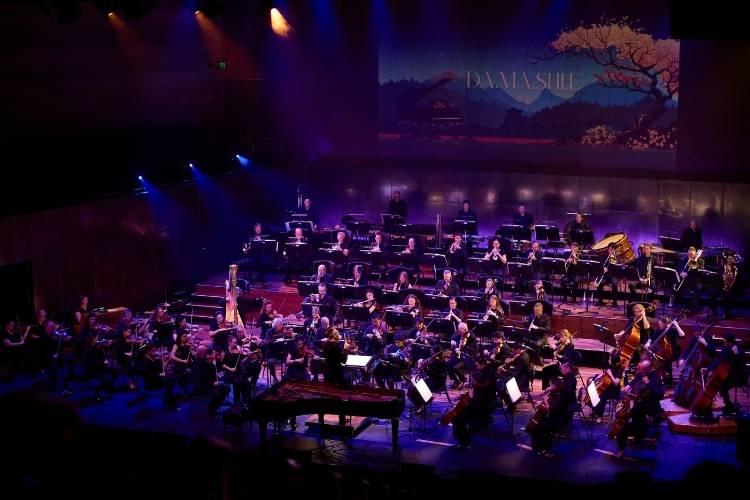
Image © Laura Manariti
Arranged by Buc for the 80-piece Melbourne Symphony Orchestra, the small, glamorous piece was startlingly pretty and exquisitely accomplished for what essentially embodies a playful musical joke. It is indicative of the care and precision exercised by Buc in his arrangement of each of the Hisaishi works performed, as each of them maintained a uniformly glossy, adventurous texture.
This is notable in that each of these pieces, from various decades, will have originally been composed and orchestrated for widely differing ensembles and recording environments. To have rendered them all so cleanly here, with so much vitality and character, is mightily impressive.
In all, the concert was finely programmed in light of the pitfalls often suffered by extremely famous musicians, in which they are best-known for six things and that is all one ever hears in later retrospectives. Here, Nicholas Buc shared a fine balance of greatest hits – ‘My Neighbour Totoro’, ‘Spirited Away’ – and hidden gems, such as the vibrantly minimalist ‘DA.MA.SHI.E’, in a fabulous commemoration of the beloved composer.
‘The Music Of Joe Hisaishi’ also represents my final live music review in Australia, as I relocate to Berlin at the end of this month. To have this performance as the chapter-end to my Australian arts writing stands as a fine send-off, and a lasting reminder of the dynamism and craft of the Melbourne Symphony Orchestra.