
When we think of 'Cinderella', our minds naturally drift toward the Disney tale of glass slippers, pumpkin carriages and midnight enchantment.
Rossini’s 'La Cenerentola', however, swaps the fairy godmother for a ragged sage, trades the famous fitting shoe for a golden bracelet, and propels the entire fairytale through a whirlwind of social ambition, theatrical mischief and sparkling orchestral crescendos.
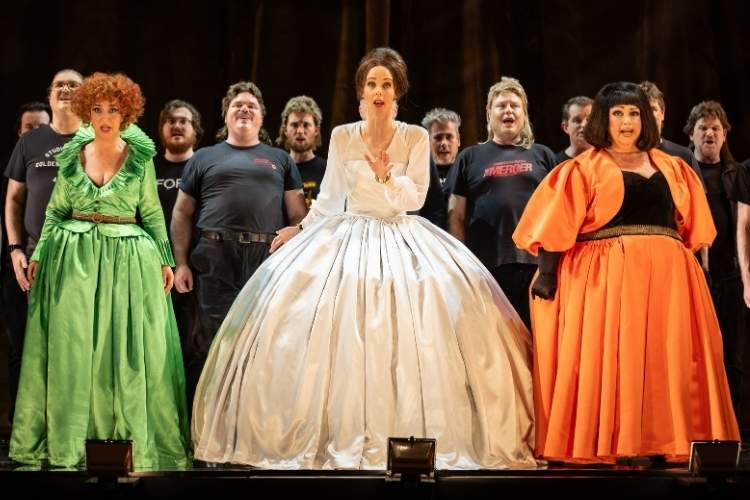
That theatrical absurdity finds its own kind of midnight magic in State Opera South Australia’s latest production, where director Neil Armfield, choreographer Garry Stewart and designer Stephen Curtis spin Rossini’s masterpiece into a retro '70s fairytale of golden glamour, spiralling vanity and delightfully-choreographed mayhem, all unfolding within an industrial world that feels equal parts backstage chaos, suburban nostalgia and operatic fever dream.
Premiering in 1817 while Gioachino Rossini was still in his twenties, 'La Cenerentola' arrived during the composer’s remarkable rise across Europe. Long before opera became adorned with the heartbreak of Puccini’s Mimì and Tosca or Verdi’s Violetta, Gioachino Rossini revelled in wit, velocity and theatrical precision, crafting music that sparkles with unmistakable Italian flair and humanity.
Act I throws Angelina headfirst into a household vibrating with vanity and self-importance with the kind of ambition in this day and age, usually reserved for reality television. While her stepfather, Don Magnifico dreams of marrying his daughters into wealth, Angelina quietly cleans around the edges of the chaos as the only sensitive soul trapped inside a house slowly caving in on its own ego. Making her role debut, Anna Dowsley brings real warmth and groundedness to Cinderella, preventing Rossini’s fairytale from slipping beneath the scripted chaos. Around her, however, the world becomes increasingly maddening. Helena Dix and Indyana Schneider throw themselves headfirst into the ridiculousness of Clorinda and Tisbe, reimagining the infamous stepsisters as two overdressed women perpetually teetering on the edge of catastrophe.
Vocally, 'La Cenerentola' remains one of bel canto’s most exhilarating balancing acts, demanding extraordinary agility from its cast but a love story depicted in cascading interweaving sequences and dynamic contrast between prince Don Ramiro, sung eloquently by Jihoon Son, and Dowsley instantaneously felt like you were about to witness something special. Critically acclaimed local baritone and Elder Conservatorium vocal lecturer (lucky kids), Teddy Tahu Rhodes, relishes every second as the wildly self-important Don Magnifico, swaggering through Rossini’s script like a man who fully believes he is the most important person in the room. Embodying character comes naturally to Teddy. Helena is a particular standout, delivering comedic wit matched with a voice that projects effortlessly to the back of the sold-out theatre. By the end of the act, disguises are flying, ambitions are collapsing in real time and Rossini’s music barely pauses long enough to catch its breath.
Directed by Anthony Hunt, the chorus becomes one of the production’s greatest comic weapons and quite possibly one of the best elements of the entire opera. A cluster of mullets and a very particular kind of Australian blokiness that lands somewhere between pub rock nostalgia and a beautifully controlled operatic unraveling against the production’s industrial backdrop. Their almost stagehand-inspired uniform, designed by Curtis, of black graphic tees subtly nods to the crossover that exists so naturally between disciplines in Adelaide’s arts scene, quietly highlighting just how much talent circulates within this city. These are singers equally at home drifting between opera, musical theatre and whatever other stage happens to call them next. Beneath the rough-edged '70s satire, however, sit some of the city’s finest male voices, with the ensemble delivering some of the loudest laughs of the night while remaining musically brilliant throughout.
Act II begins peeling back the fairytale spectacle to reveal something more sincere underneath as mistaken identities unravel. Nicholas Lester ties in the metaphorical notion that the entire cast have been performing versions of themselves the entire opera, having established himself as the Prince in his genuinely satirical performance of Dandini. What a fool believes. Every character trapped inside desperation and yet, the mask is truly taken down when he reveals himself both metaphorically and musically. The acting within the acting is on another level and comic manipulation grounds itself in honesty.
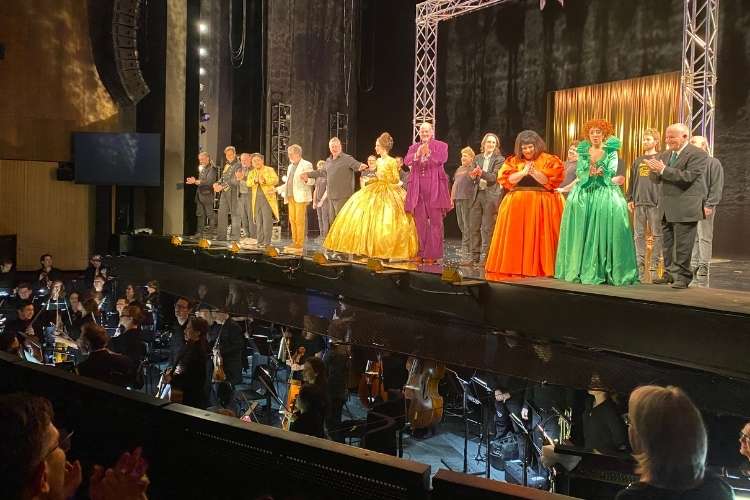
Image © Kara White
Though the fairy godmother is replaced by a ragged jester in this story, taking the form of a suburban contemporary vagabond with a trolley full of checkered suitcases, there remains a very real air of mystic woven through Rossini’s Act II sextet, Questo è un nodo avviluppato, where six voices ricochet between one another before being mirrored almost hypnotically by the orchestra beneath them. Here, Pelham Andrews comes vividly to life as the philosophical puppeteer, Alidoro, steering the opera not through supernatural magic, but through rhythm, musical architecture and carefully orchestrated human connection. A job he takes on physically and spiritually so well. The staccato vocal lines create a spell-like sensation as the music grows increasingly psychologically tangled, characters physically pulled together and reshaped around Alidoro’s quiet influence.
Perhaps the most compelling part of it all is that Rossini’s magic never fully leaves reality; it is real, showcasing composition and storytelling at its finest and the extraordinary power music can have on an audience. A clever moment comes in the brief wave of a cheap-looking light up magic wand – the kind seemingly straight from a Disney souvenir stand – gently acknowledging the fairytale Rossini deliberately leaves behind while hinting at a more human form of magic altogether and possibly fixing up a different kind of mess.
Under the baton of Stuart Stratford, the Adelaide Symphony Orchestra sustains Rossini’s restless momentum with remarkable stamina across an undeniably demanding score. Rossini is repetitive and crazy. Rising cadences return again and again with buoyant energy, while crescendos unfold in polished waves from scene to scene. Rossini opera is no easy feat for an orchestral musician, yet the ASO navigates the sheer density and pace of the Italian work with elegance and discipline throughout, maintaining clarity and precision even in the score’s most energetic passages.
A storm scene showcases the extraordinary depth of lighting designer Nigel Levings' talents. A carriage not cast in the opera, etched in the shadows of a curtain draped over the stage mid-performance in the eye of a (storm), hints toward a relevance of Charles Perrault’s original 1697 folk fairytale literature. The story itself, being even older with variations appearing across Ancient Greece, Egypt, China and oral folklore traditions worldwide.
Rossini’s Non più mesta proves to be a dream Dowsley’s heart makes in one final act, embracing the role’s dazzling bel canto fireworks with spine-tingling control, depth and virtuosity. Underlying the theatrical excess sits a surprisingly simple notion where kindness wins. Forgiveness overtakes vanity, sincerity cuts through performance, and Cinderella’s transformation feels as if misery has vanished from a fairytale.
Fairytales, after all, are not simply embedded in storybooks or cartoon films. In Rossini’s world, the emphasis shifts toward human behaviour and morality rather than supernatural destiny. A reminder that transformation and brilliance can still emerge from humanity itself and the curtain won’t close until we’ve fully accepted it.