
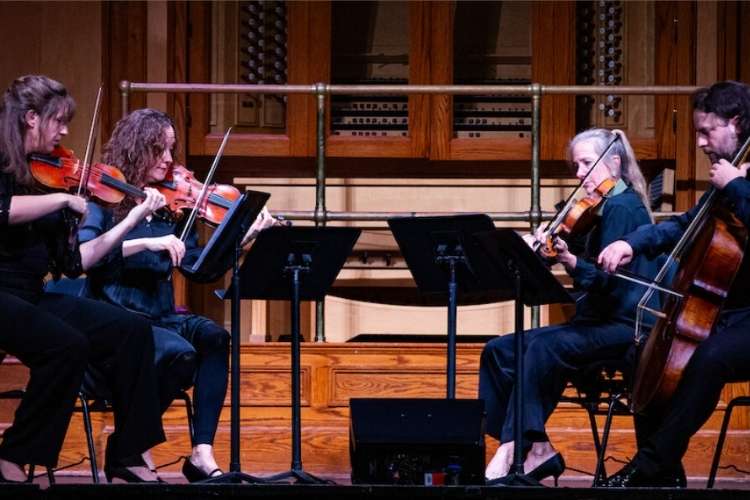
1809: the year Haydn died and Mendelssohn was born. Two classical composers at opposite ends of the 18th century classical period.
What makes the programming of this show so alluring is although Mendelssohn was considered a romantic composer and Haydn had emerged from the baroque period, there are so many parallels in the way the music moves. At a time when Beethoven was emerging, soon to be considered the most popular composer of the era, Mendelssohn was revelling in a time warp, writing quartets with a rich, classical feel, modelled on those he had heard before his time. When we think of classic baroque music, our minds naturally gravitate to Johann Sebastian Bach. It has been noted that Mendelssohn was responsible for unearthing and bringing awareness to Bach’s music almost a century after his death.
Drawing classical bows across wound-gut strings on period instruments, The Adelaide Baroque Quartet eloquently brings these two works to life in a new show called 'Enlightened Quartets, Music From The Age Of Enlightenment'. The principals of the time of the Age Of Enlightenment include democratisation, individualism, humanism and science and reason; which saw the overcoming of superstition. The classical era was the embodiment of this and it was mentioned in the show that nothing in classical music captures the true essence of the Age Of Enlightenment more so than the string quartet. Alison Rayner (violin), Janet Anderson (violin), Heidi von Bernewitz (viola) and Tom Marlin (cello) make up these four parts of equal standing, coming together democratically as individuals to shape the music. For those who don’t know, generally a quartet has four movements with a few exceptions like some of Beethoven’s works.
The first work, Haydn op. 77, no. 1, was the first in a set of two string quartets. Joseph Haydn usually wrote in sets of six but he was getting old and less capable by this point. It was composed in 1799 which was just ten years before he died, making this one of the last quartets he wrote. The first fiddle, played by Alison Rayner, provides the primary thematic material in the first movement, with commentary from the other instruments. There is a lot of interplay with arpeggiated runs and the development flirts with moving from the original key in G major into E minor before the recapitulation. The second movement is the lyrical heart of the piece with a solemn, nostalgic texture and the reintroduction of the opening theme is immediately followed by a brief flirtation with the tonic minor providing arguably the most heart-wrenching moment of the entire string quartet. The third movement is a Menuetto and Trio; a fast Minuet in G major written in 3/4 time, contrasted by an energetic and lively Trio in Eb major, which was taken at a much faster tempo than usually played, breaking up the mood before the return of the Minuet. The fourth and final movement is rounded out with a fast finale, full of excitement and drama.
The performance took place at The Roche Museum and Gallery in the Roman Room, which is exactly how the mind would perceive that at first thought. . . Fully fitted out with statues of half-naked people. It was one of the strangest places I’d ever entered, even encompassing a Chinese loo! The artefacts, including numerous sculptures almost seemingly pay homage to classical antiquity, ironically the era that gave birth to enlightenment concepts such as democracy thousands of years earlier.
This Mendelssohn quartet features a ‘song’ or motif in the opening of the first movement and the end of the last movement titled 'Ist es wahr?', or, for those who don’t speak German, 'Is is true?' The first movement’s lyrical opening in A major really opens the door to this playful quartet, springing to life later in the movement as a lively gesture in A minor. The second movement has an F major opening with a surprise fugue in the middle section like a conversation between second violinist, Ali and Heidi on the viola that interchanges into D minor with the opening theme before building to extreme heights of intensity and volume carried through with heavy vibrato and bow pressure to match the intensity which could be likened to that of a pressure cooker. The first violin returns the music to the opening theme of the movement with a stand-alone solo before moving into the Intermezzo; the third movement of the piece. This opens with a simple melody in A minor, played by Janet Anderson, delicately encased by pizzicato strings with a fast and spritely middle section in A major which is a total reverse of the first movement of the work. After returning to the opening theme, the coda brings the music to an end with a fast accelerando played at the softest dynamic in the movement.
The fourth and final movement begins with recitative-style solo from the first fiddle, accompanied by electric tremolos from the other instruments providing suspense and setting the scene for a fire and brimstone finale with a full-bodied, heavy, driving bottom end played by Thomas Marlin that eventually settles into calmer waters. The finale ends with the reintroduction of lyrical themes from the second and first movements, respectively, providing closure to what seemed like an open question left unanswered.
With this being one of the only true classical music performances at Adelaide Fringe, it was very well received by the audience and it’s not just a show for old people as this music is generally profiled.